
Pinned collection
21 free calculators. One place.
Start with the money decision in front of you. Every tool is free to use and no account is needed.
Browse the complete library
Latest from HowToMoney
Explore calculator stories, sourced statistics and practical financial updates. Each item explains why the question matters and where you can explore it further.
Start with the money decision in front of you. Every tool is free to use and no account is needed.
Browse the complete libraryDaily insight
New statistics, helpful explanations and relevant industry developments will be added here as they are researched and reviewed.
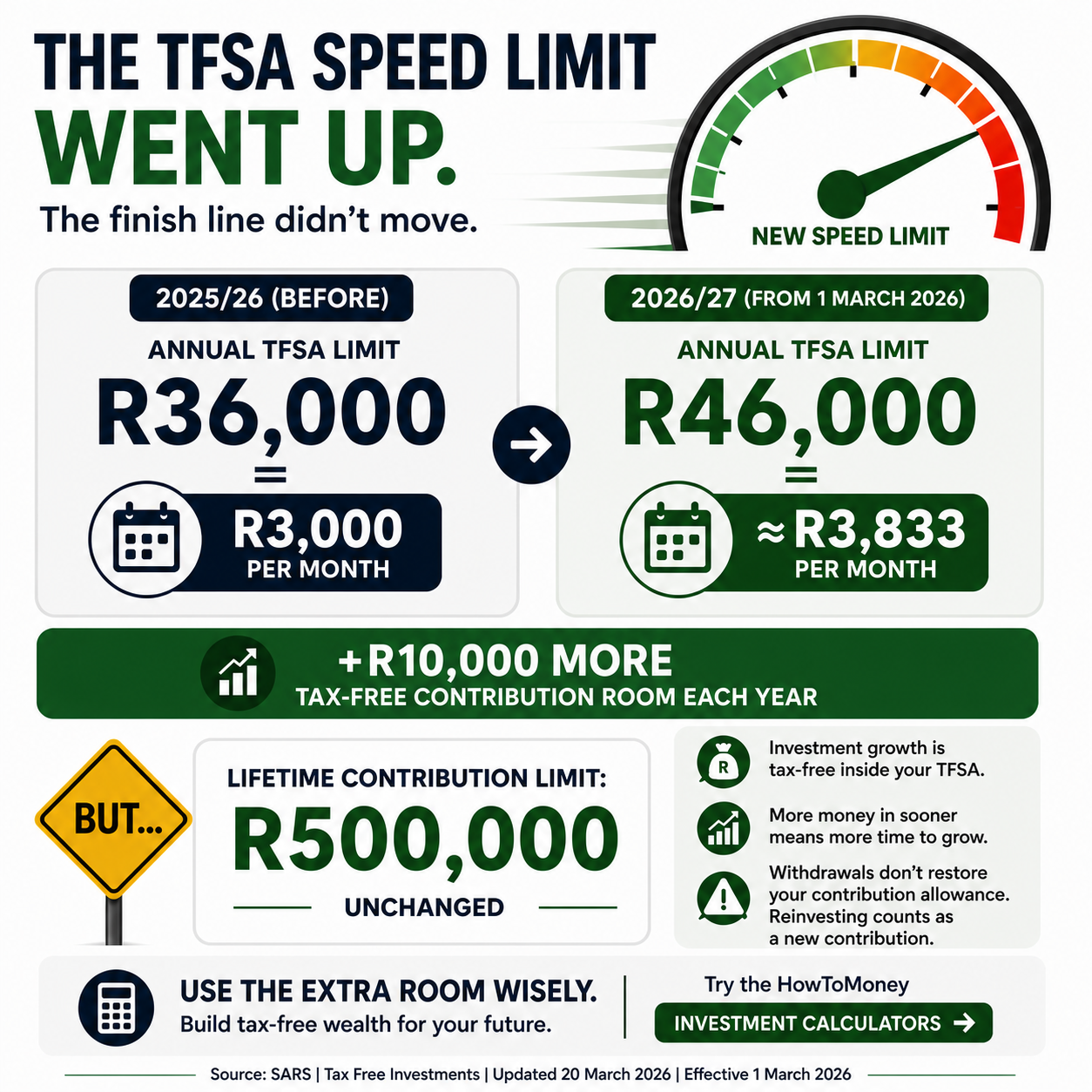
From 1 March 2026, South Africa's annual Tax-Free Investment contribution limit increased from R36 000 to R46 000. That is R10 000 more annual contribution room and an approximate monthly budgeting equivalent of R3 833 instead of R3 000.
The lifetime contribution limit remains R500 000. This is a limit on contributions, not the account value, so tax-free investment growth may take the balance above R500 000. The higher annual limit can move more money into the tax-free environment sooner, giving it potentially more time to compound. Withdrawals do not restore contribution room, and reinvesting a withdrawal generally counts as a new contribution.
R3 833 per month is an approximate budgeting equivalent of the R46 000 annual limit, not a separate monthly limit. The R500 000 lifetime limit applies to contributions, not investment growth. Limits apply in aggregate across all your tax-free investments. Unused annual contribution room does not carry forward, and excess contributions may attract tax of 40% of the excess. General financial education only. Individual circumstances differ.
Browse every sourced statistic and explanation in date order.
Calculator stories
Read the short story behind each tool, then open the calculator to test the decision using your own numbers and assumptions.
Project long-term values and test whether retirement income may remain sustainable.
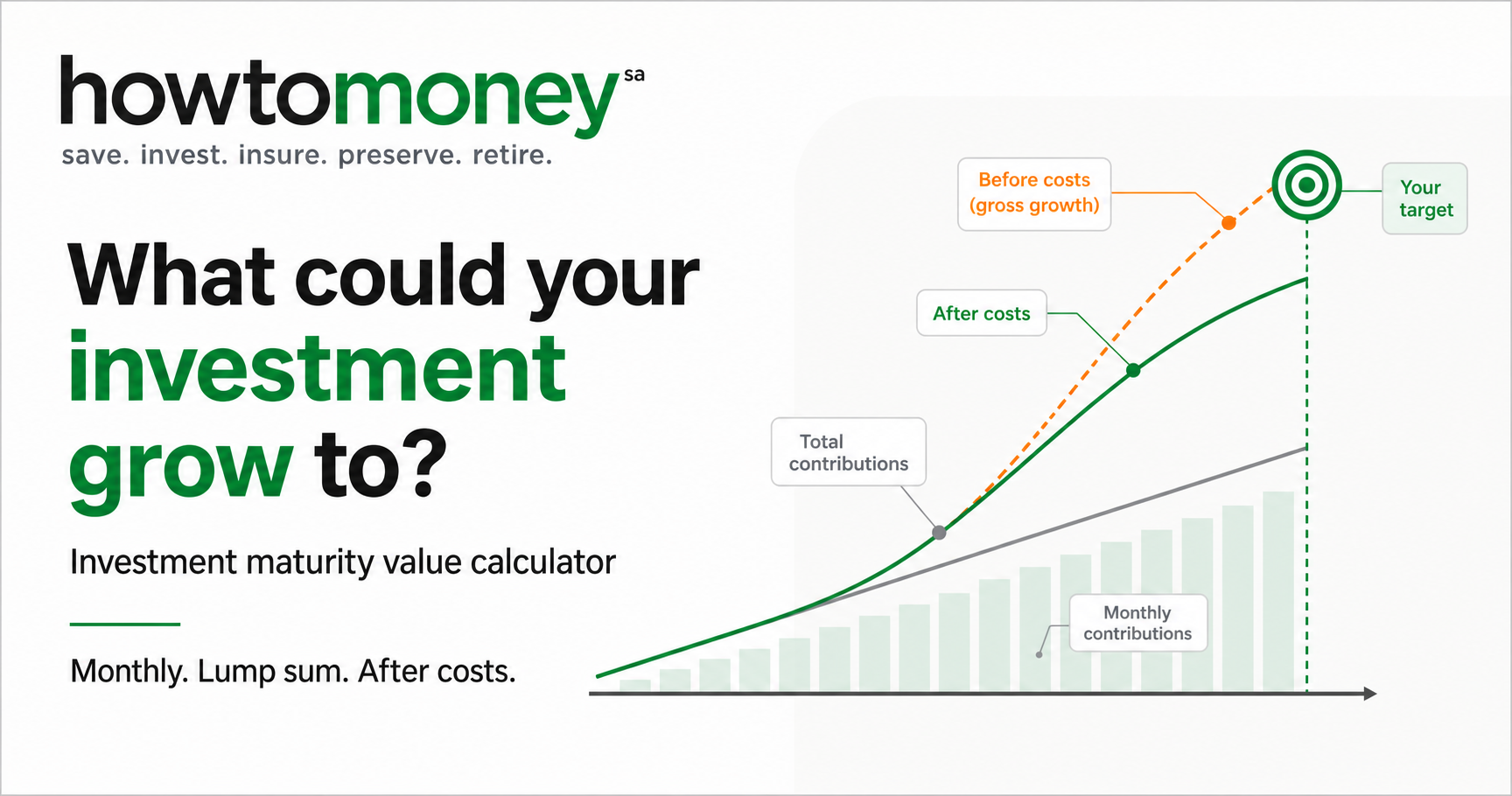
What might your investment grow to?
Investment growth is shaped by more than the headline return. See how a lump sum, monthly contributions, yearly increases and costs work together over time.
Explore calculator
How much of your salary should you save?
A retirement target can feel distant until it is translated into a contribution today. Estimate the percentage of gross salary your chosen retirement income may require.
Explore calculator
What could cash now cost you at retirement?
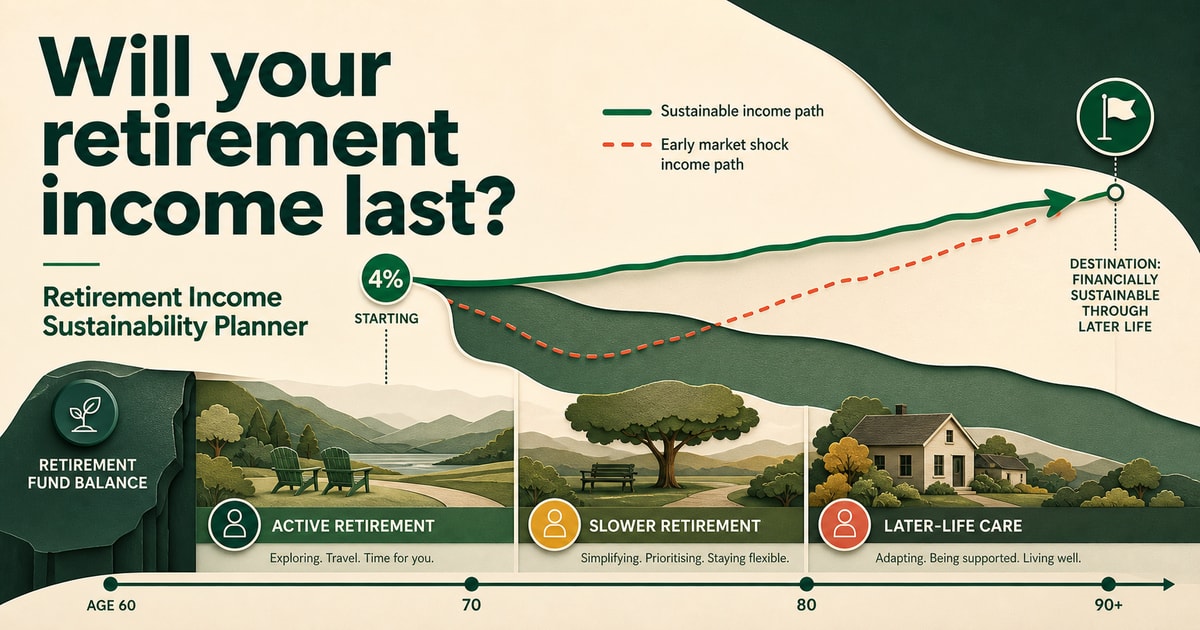
How long might your retirement income last?
Reaching retirement is only the start of the income challenge. Test how withdrawals, inflation and the timing of returns may affect how long capital lasts.
Explore calculator
How resilient is your plan across 10 000 futures?
One average return can hide thousands of possible journeys. Explore the probability of success across changing markets, spending behaviour and household longevity.
Explore calculator
How much certainty and flexibility should your retirement income combine?
Retirement income can combine certainty and flexibility. Compare a living annuity, guaranteed lifetime income and a blended strategy designed to cover essential expenses first.
Explore calculator
How should retirement capital balance income certainty and flexibility?
A retirement-income decision starts with the household, not the product. Classify expenses, set a tax-aware income floor, compare four allocation structures and test what happens after the first death.
Explore calculatorExplore insurance needs and compare the financial structure of medical-scheme options.

What should your financial safety net cover?
Protection and saving are often planned separately, even though both compete for the same income. Bring cover needs, emergency savings, future goals and retirement into one view.
Explore calculator
Which plan structure fits the way you use healthcare?
The monthly contribution is only one part of a medical-scheme decision. Compare plan structures, medical savings and possible out-of-pocket costs alongside the benefits received.
Explore calculatorUnderstand income, spending, debt and the next decision in front of you.
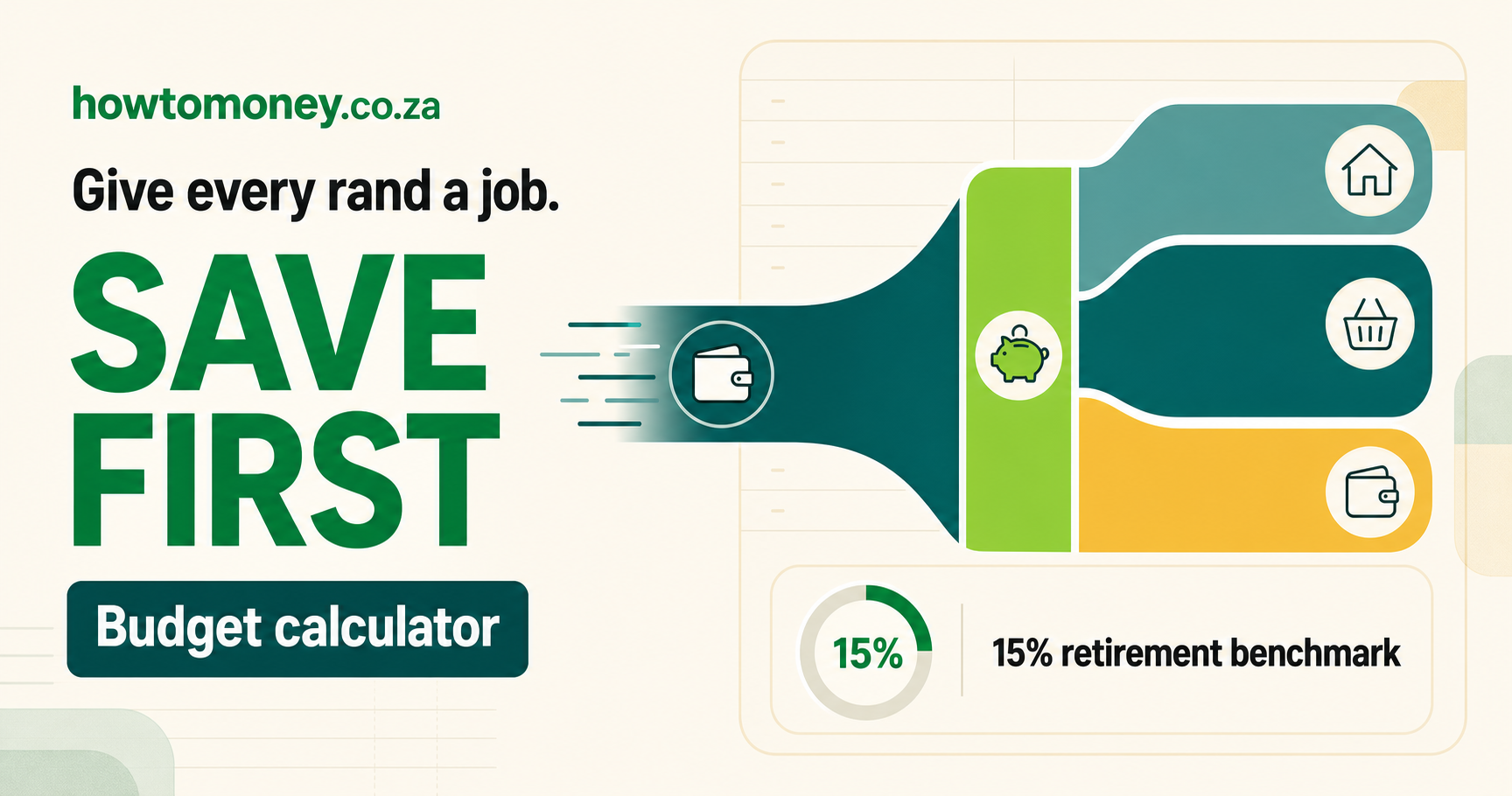
Where is your money going each month?
A budget should fund priorities before it explains where the money went. Build saving into the plan, separate essential and flexible costs, and see what remains.
Explore calculator
What could your take-home pay be?
Gross salary is not the amount available to spend. Estimate PAYE, UIF and take-home pay while allowing for retirement-fund contributions and the selected tax year.
Explore calculator
Which debt should your next rand attack?
The order in which debts are repaid can change both the interest bill and the debt-free date. Compare strategies and see where an additional payment may work hardest.
Explore calculator
Where should your next R1 000 go?
When another R1 000 becomes available, several priorities may compete for it. Work through a transparent decision ladder covering cash flow, protection, debt and long-term goals.
Explore calculator
What could the same basket cost elsewhere?
Small grocery price differences can become meaningful when they repeat every week. Compare a matched Gauteng basket and then build a basket around the products you buy.
Explore calculator
What happens when the same bet is repeated?
Short-term wins can make chance feel beatable. Repeated simulations reveal how the house edge becomes clearer as more bets and sessions are played.
Explore calculator
Where might your net worth place you?
Net worth is a useful balance-sheet measure, but South Africa's highly skewed wealth distribution needs careful context. See a broad research-based position without false precision.
Explore calculatorUnderstand home-loan costs and explore the long-term buy-versus-rent decision.

What does the home really cost over time?
A monthly repayment does not show the complete cost of a home loan. Explore interest, transfer and bond costs, plus the effect of paying extra each month.
Explore calculator
Could buying or renting leave you better off?
A home is personal, but the financial comparison should still be honest. Compare ownership and renting after upfront costs, escalating expenses and invested differences.
Explore calculatorLook beyond the instalment to the full cost of transport and travel choices.

Can your budget carry the whole vehicle cost?
The finance instalment is only the beginning of a vehicle's effect on household cash flow. Expand the estimate to running costs, balloon risk and affordability stress tests.
Explore calculator
What does every kilometre really cost you?
Fuel is the most visible driving expense, not the only one. Estimate marginal and complete vehicle costs per kilometre, then compare a journey with ride-hailing.
Explore calculator
Is the journey part of the holiday?
The cheapest journey is not always the best holiday choice. Compare cost, group size, travel time and the experience of flying and renting versus driving your own vehicle.
Explore calculatorContinue the conversation
New calculators, practical explanations and sourced money insights will be shared across our social channels.
HowToMoney provides independent financial education and illustrative estimates. Content is general information, not personal financial, tax, legal, medical-scheme or investment advice. Time-sensitive facts are date-stamped and linked to their stated sources.